
Exploring the Culture, Traditions, and Life of the Bonda Tribes of Odisha
The Bonda Tribes of Odisha represent one of India’s most ancient and isolated indigenous communities, residing in the remote hilly regions of Malkangiri district in southwestern Odisha. Also known as Bondo, Remo, or Bonda Poraja, this Munda ethnic group numbers around 12,000 people, with the Upper Bondas maintaining greater isolation compared to the Lower Bondas. Their habitat lies near the borders of Odisha, Chhattisgarh, and Andhra Pradesh, where dense forests and rugged terrain have preserved their distinct way of life for centuries.
The Bonda tribes Odisha are classified as a Particularly Vulnerable Tribal Group (PVTG), relying primarily on subsistence agriculture, shifting cultivation (known as podu), and forest produce collection. They cultivate paddy, maize, millets, black gram, and oilseeds, supplemented by hunting and gathering. Their economy includes barter systems in weekly markets like Onukudelli, where limited interactions with outsiders occur. The Bondas speak Remo, an Austroasiatic language from the Mundari group, and maintain low literacy rates, reflecting their limited exposure to mainstream society.
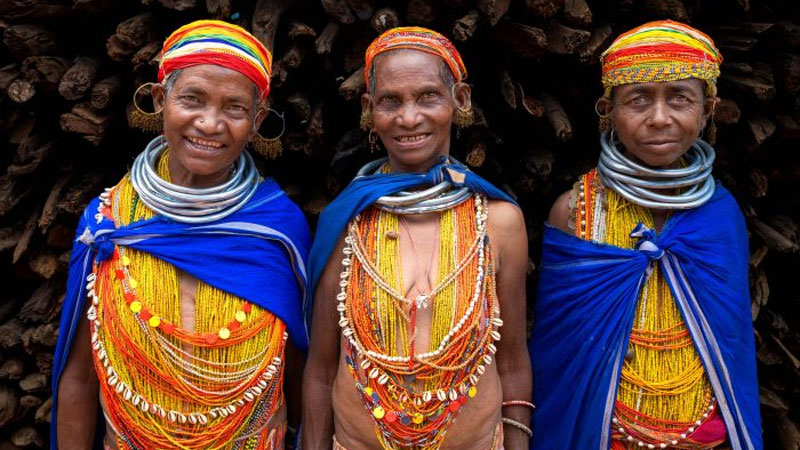
One of the most striking features of the Bonda Tribes of Odisha is their traditional attire, especially among women. Upper Bonda women wear a narrow strip of cloth called ringa to cover the lower body, while adorning their upper body and neck with heavy aluminum neckbands, multiple layers of bead necklaces, and intricate silver jewelry that reaches the waist. Their heads are often shaven and decorated with bead headbands and wild grass. Men typically wear minimal clothing and carry traditional weapons like arrows. This unique style, combined with body art, highlights their artistic heritage and cultural identity.
Socially, the Bonda Tribes Odisha follow a hierarchical structure led by a council of elders. Their society emphasizes community decisions, with animistic beliefs centered on nature worship and ancestral spirits. The chief deity is Mahaprabhu, the Great Lord. Festivals play a vital role in their lives, including Maghe Parab for harvest celebrations with prayers, dances, and tribal music; Sume Gelirak, a multi-day thanksgiving event with rituals and merriment; and Chaitra Parva, featuring sacred dances and spiritual observances. These occasions strengthen bonds and honor deities for bountiful yields.
Despite modernization pressures, the Bonda Tribes of Odisha strive to preserve their heritage amid challenges like habitat loss and low life expectancy. Visiting Malkangiri offers a rare glimpse into this enigmatic community, but respectful tourism is essential to protect their traditions.
